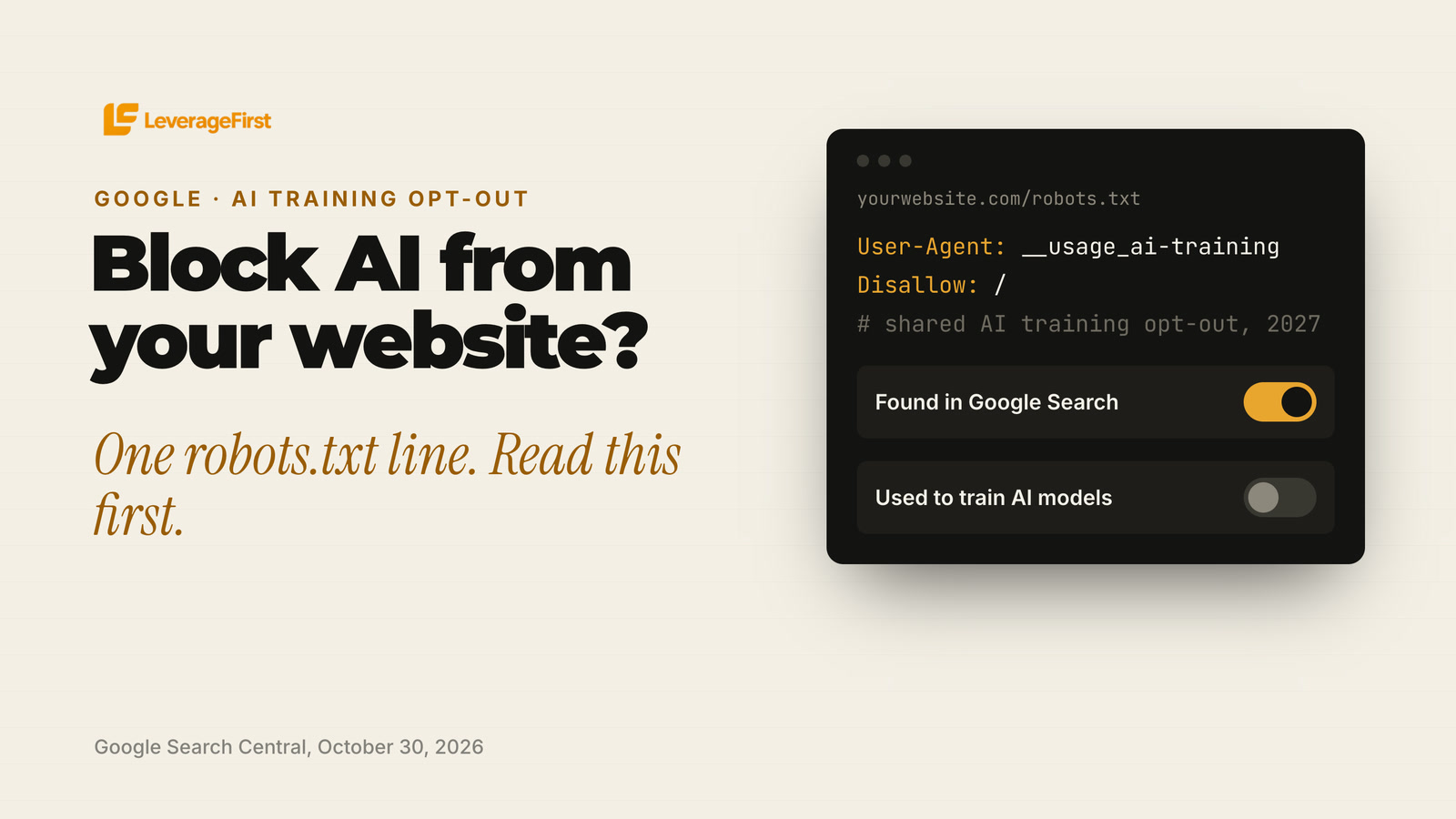
On October 30, 2026, Google said it plans to honor a shared AI training opt-out in robots.txt in 2027. It only covers training AI models. It does not remove you from Google Search. For most service businesses, blocking AI is the wrong move: being cited by AI answers is now one of the ways new clients find you.
What Google announced
In a Google Search Central post on October 30, 2026, Google said it intends to support a shared AI training control in robots.txt, based on work by the IETF’s AIPREF working group. The goal: one line in your robots.txt that tells every participating AI company “don’t train on my site,” instead of blocking each crawler one by one. Google says it aims to support it in 2027.
The signal is a policy token called __usage_ai-training, described in an IETF Internet-Draft. OpenAI, Microsoft and Anthropic were also reported as backing the shared signal (Search Engine Journal, Search Engine Roundtable).
Disallow: /
The draft is still being debated at the IETF, so the final syntax could change before 2027. Don’t copy it into production until Google publishes final documentation.
What it does, and what it doesn’t
It covers
- Whether participating AI companies may train their models on your pages
- At Google, it’s treated like disallowing Google-Extended if you don’t set that separately
- One rule for many AI providers at once
It doesn’t
- Remove you from Google Search results
- Act as a ranking signal. Google says Google-Extended does not affect inclusion or ranking in Search (Google docs)
- Hide private pages. For that you still need
noindex
One detail matters if you care about AI visibility: Google says sites that explicitly allow Google-Extended stay eligible to appear in Gemini answers and receive clicks through grounding. Opting out of training through the shared token, without allowing Google-Extended, may reduce that.
Disallow: /
User-Agent: Google-Extended
Allow: /
Should your business block AI? 3 quick questions
Our take for service businesses
If you run a clinic, a law office, a brokerage or a home service company, your website’s job is to get you hired. More people now ask ChatGPT, Gemini or Copilot “who should I call for…” before they ever open Google. Blocking AI protects content you aren’t selling and costs you visibility you need.
- Keep your public pages open to search and AI crawlers.
- Make them easy to quote: a clear answer near the top, real prices, your service area, and your name and credentials.
- Protect what’s private with logins and
noindex, not with a training opt-out.
We just did exactly this on our own site: public guides stay open, and every customer-generated page in our Studio app is set to noindex. See our AI receptionist price guide for an example of a page written to be quoted.
Want to be the business AI recommends?
LeverageFirst builds the systems that catch every lead (AI receptionist, missed-call text-back, follow-up) and helps your site get found by Google and AI assistants. Live in 7 days or the first month is free.
Book a 20-minute callThe takeaway
Google’s shared opt-out is a useful tool for publishers who sell content. For most service businesses, the smarter play in 2027 is the opposite: stay visible, make your pages easy for AI to quote, and keep private information private.
Frequently asked questions
What is Google's new AI training opt-out?
On October 30, 2026, Google said it plans to support a shared AI training control in robots.txt in 2027, based on an IETF draft. A single policy token, __usage_ai-training, would tell participating AI companies not to train models on your site.
Will blocking AI training remove my site from Google Search?
No. The control is about AI training. Google says Google-Extended does not affect a site's inclusion or ranking in Google Search, and the shared opt-out is treated like a Google-Extended disallow.
Can I use the new robots.txt token today?
Google says it intends to support it in 2027, and the IETF draft may still change. Wait for Google's final documentation before relying on it.
Should a small service business block AI crawlers?
Usually not. If your website exists to bring in clients, being cited by AI assistants helps people find you. Protect private pages with logins or noindex instead.